|
Verwood Station and the
Salisbury & Dorset Junction Railway. |
Southampton
and Dorchester Railway Company.
In 1844 the 'Southampton and Dorchester Railway
Company' was formed to build a line between the two towns.
The route chosen snaked (Castleman’e Snake) across the New
Forest from Northam to Ringwood, then via Wimborne to
Hamworthy, (the junction for Poole) before heading on west
to Dorchester.
Because of the twists and turns the line was
nicknamed 'Castleman's Corkscrew' after Charles Castleman,
the Wimborne solicitor who was chiefly responsible for the
building of the line. This railway was opened on the 1 June
1847.
Salisbury
& Dorset Junction Railway
22nd July 1861 - Parliament granted the independent
‘Salisbury & Dorset Junction Railway’ its act to
link with Southampton, Dorchester and Wimborne railway.
 3rd
February 1864 saw building start at Downton. A ceremony was
held with the Countess Nelson, who was married to Horatio
Nelson, turning the first sod. She lived in Downton and was
the daughter of the 2nd Earl of Normanton. 3rd
February 1864 saw building start at Downton. A ceremony was
held with the Countess Nelson, who was married to Horatio
Nelson, turning the first sod. She lived in Downton and was
the daughter of the 2nd Earl of Normanton.
20th December 1866 – The 19 miles of
single track line was opened from Alderbury Junction
(between Salisbury and Dean) to West Moors and formed a link
between Poole and Salisbury passing through Downton,
Breamore, Fordingbridge, Daggons Road (Alderholt) and
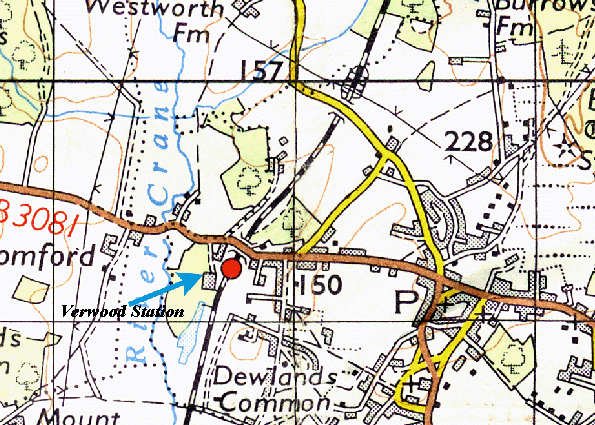
Verwood (OS Grid Ref: SU077093). The track followed the River
Avon along the New Forest western edge.
The bypassing of Cranborne reduced its importance
and caused the expansion of Verwood which until then had
been a minor Hamlet in the Cranborne district known as
Fairwood.
It was a single track line with 4 passing loops and
one of these was at Verwood Station.
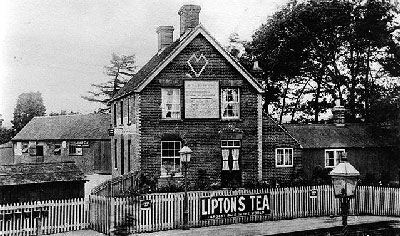 The
Albion Inn with its attached stables was built in the
Station yard, which was rather unusual and these can still
be seen to the north side of the B3081 road which was
re-routed to avoid the railway bridge, and now passes
through the demolished station and station masters house. The
Albion Inn with its attached stables was built in the
Station yard, which was rather unusual and these can still
be seen to the north side of the B3081 road which was
re-routed to avoid the railway bridge, and now passes
through the demolished station and station masters house.
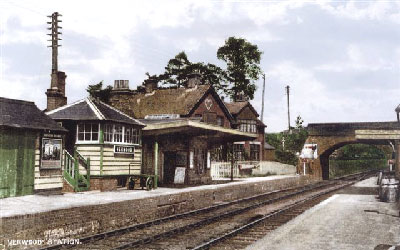
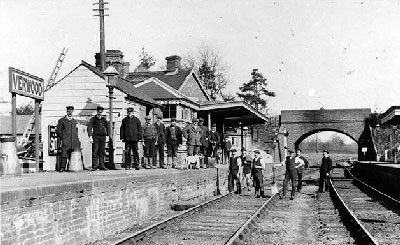
The station buildings included a canopied platform
on the up line along with the signal box whereas the down
platform only had a canopy. There were few changes in its
life and the lighting was by oil lamps until its eventual
closure
in 1964.
A number of girls used to travel by train to school
in Parkstone and they still meet regularly today in the “Verwood
Heathland Heritage Centre”; they are known as the train
girls. The boys went to Wimborne Grammar School. The railway
also enabled Verwoodians to go shopping in Poole.
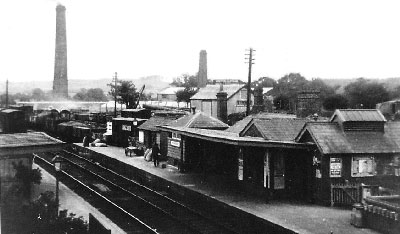 The adjoining goods yard with cattle pens, a
crane and a coal depot encouraged local trade and industry
which included the exportation of sand, bricks, timber and
other goods. Unfortunately it also encouraged the
importation of household “enamel ware” which led
to the gradual cessation of the Pottery Industry. The last
pottery, which closed in 1954 was the Crossroads Pottery,
now the Verwood Heathland Heritage Centre. The adjoining goods yard with cattle pens, a
crane and a coal depot encouraged local trade and industry
which included the exportation of sand, bricks, timber and
other goods. Unfortunately it also encouraged the
importation of household “enamel ware” which led
to the gradual cessation of the Pottery Industry. The last
pottery, which closed in 1954 was the Crossroads Pottery,
now the Verwood Heathland Heritage Centre.
As
Bournemouth
increased in population and with motor transport available
many farmers in Woodlands and Verwood found it more
profitable to send their milk to Bournemouth. Many other
farmers took their milk to Verwood railway station around 6
p.m. to be sent to
London.
Verwood was the nearest
station to the large Houses of the many “important”
people living in the area and so a number of important
personages alighted or passed through the station including
King Edward VIII, Queen Alexandra, King George VI and Queen
Elizabeth.
1914 – Women took over the running of the
Railways when they came under Government control as WWI
broke out.
1923 - The 'Big 4' companies were created -
"Great Western", "Southern",
"London & North Eastern (LNER)" and
"London, Midland & Scottish (LMS)" from the
remaining small companies.
The Verwood line was now part of the Southern Company.
1939 - Railways become a prime target for bombing
in WWII and the railways came under government control
yet again.
1945 - The Labour Government reintroduced the 'Big
4' and pledged Nationalisation but funds were too low at
that time.
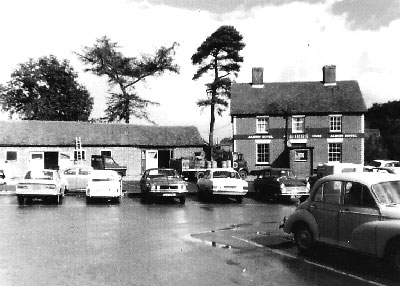
This
picture shows the Albion after the closure of Verwood
Station.
The Station Yard is being used as a car park for Lessers
Building Systems.
1947 - Royal assent is given to the Transport Act,
which set the scene for the national ownership of the
railways and canals.
1948 – Nationalisation occurred and the 'Big 4'
companies now become 6 regions: Southern, Western, London
Midland, Eastern, N. Eastern and Scottish. The line through
Verwood came under British Railways (Southern Region)
1955 - British transport Chairman announces £1.2m
plan for replacement of steam with diesel/electric traction.
1961 - Dr Beeching is appointed as chairman of the
British Transport Commission under the Minister for
Transport Ernest Marples.
1963 – Dr Beeching proposes cuts to the railway
system and many smaller village stations (including Verwood)
and lines are closed. The Great Train Robbery takes place at
Seers Crossing.
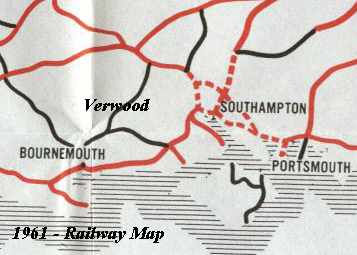
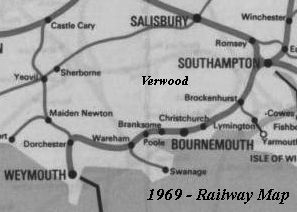
The maps show the railways before and
after the Beeching Cuts.
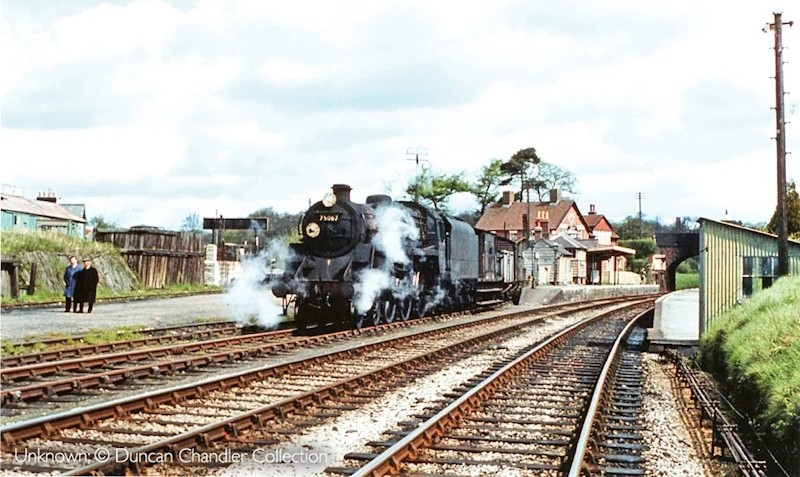
This view from the south end of Verwood station on was taken on
the 1st May 1964, the Friday immediately before the final closure and
shows much of the layout of the station at Verwood. The Albion Inn can be seen
behind the "Up" platform. The brickworks provided much of the traffic and had
its own private siding. The loop could be ‘switched out’ during quiet days to
allow all trains to pass along the "Up" side. The road bridge still remains in
situ but, after the railway’s closure, the road itself was realigned to run in
front of the Albion Inn on the level, close to where it existed prior to the
railway’s arrival in the mid-1860s. BR Standard 4MT 4-6-0 No.75067 may be
gathering the remaining wagons ahead of final closure on Monday 4th May.
(Unknown; © Duncan Chandler Collection)
The closure Verwood Station was received with much regret in the area. All the
last trains were full. Traffic on the line was always light
and closure had been discussed prior to the Beeching Axe.
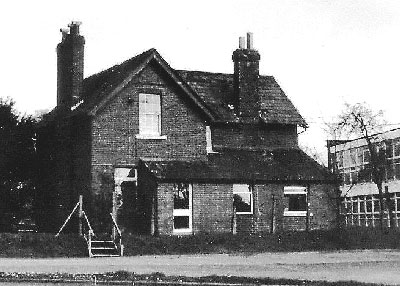
The
Station Masters house shown after closure. Lessers Office
Block can be seen on the right.
The house was demolished to make way for the re-routing of
the B3081 Road.
The Ringwood to Broadstone line continued with
goods traffic until October 1966 when it terminated at West
Moors for military requirements.
The lines were taken up and the buildings
dismantled so that dilapidation soon set in. Few
traces of its former route can be seen other than some
embankments and some bridges like the one in the Albion Pub
garden and also on the Alderholt Road.
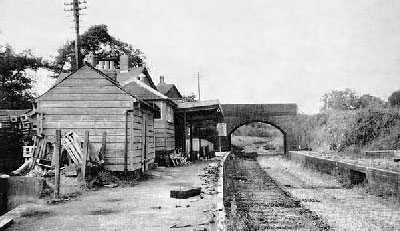
This
picture shows the dereliction after the track was removed.
THE POLITICAL
SLOT.
For more information about the infamous skullduggery that went on under the Beeching and Marples axe
then visit
https://www.bilderberg.org/railways.htm
and you may be as appalled as I was at the conflicts of
interest etc. It is only by good luck that we have any
Railways at all today. What happened to most of our Trams
for instance? Blackpool being an exception to this. In recent years more
towns have built new tramways as a convenient and greener solution.
It is unfortunate that it would now be
prohibitively expensive (and not necessarily desirable) to
open closed lines, as they were destroyed, not just closed.
Some successful re-use has been made of the old lines,
particularly in Manchester and Newcastle where they have become tramways. In addition some
railways have reopened as tourist attractions, like the
local Swanage Railway. The recent announcement that some
of the Railway bottlenecks will be removed is to be
welcomed.
JSC - Webmaster 2007.
|