|
|
Many thanks
to the "Verwood Historical Society" who
provided the following information. |
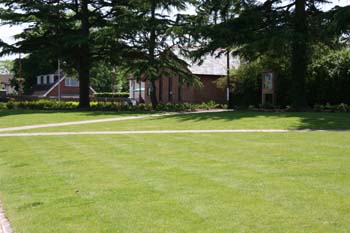
Ferrett’s Green, as the
current area in front of the Verwood Heritage Centre was
popularly known, took its name from a family who produced
and sold Earthenware at the Crossroads Pottery over several
generations in the 19th and early 20th
centuries.
Ferrett’s Green was
originally the claypit for the pottery but by the end of the
19th century the supply had been exhausted and
villagers requested that the resultant pond be filed in
because of the danger to children.
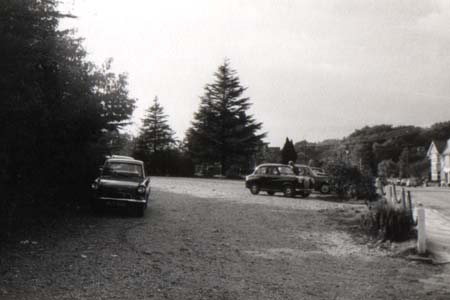 The restored area then served as
a village gathering place and later as Verwood’s main car
park (see picture), its flower beds tended by the nearby
Council
School
children as part of their gardening
lessons in the early 20th century. The restored area then served as
a village gathering place and later as Verwood’s main car
park (see picture), its flower beds tended by the nearby
Council
School
children as part of their gardening
lessons in the early 20th century.
Verwood’s heathlands, rich in
clay, sand and firing wood, provided Earthenware makers with
raw materials for many centuries. Nearby is the last
surviving workshop from this widespread industry, all that
remains of the once flourishing Crossroads Pottery. Kilns
and other remnants have been found all over the surrounding
area.
Past Ownership of the
Crossroads Pottery
(Now the Verwood Heathland Heritage Centre).
In the 1840’s CHRISTIAN FERRETT, widow of potter Amos lived near her son-in-law
Robert Shearing who lease the Crossroads Pottery premises
from Squire William
Rolles Fryer.
Christian’s son PAUL FERRETT was also a potter and it is
likely that the two brothers-in-law ran the business as a
joint venture. Robert
Shearing had no sons but PAUL FERRETT had six, most
of whom remained in Verwood and followed him into the trade.
When PAUL died in 1872, followed by Robert in 1877, the
Ferrett sons ranged from middle age to early twenties and
already had many year’s experience in the various
operations of the pottery.
Paul’s youngest son CHARLES
FERRETT born 1854, was recorded as the Pottery Manager in
1891 and a Pottery Earthenware Manufacturer in 1901. He
lived with his wife Rose and their family at the Pottery
House which stood to the rear of the present car park, once
the large and busy working yard of the Crossroads Pottery.
When CHARLES FERRETT died in
1916 the pottery came under the ownership of this eldest son
FRED FRY who used the surname of his mother’s family. Fred
was something of a legendary character in the village being
known as the “Musical Potter”.
He founded a Boys’ Band and
was said to be able to play any instrument he chose. One of
his achievements was in making a set of graduated flower
pots on which he could entertain in perfect tune.
In 1925 Fred sold the pottery to
Robert Thorne,
Owner of the village Timber Mills (then in
Dewlands Road), and it remained in this family until its
closure in 1952. The last Master Potters, featuring in many
atmospheric photographs, were Meshech Sims and Herbert (Bert) Bailey.
|
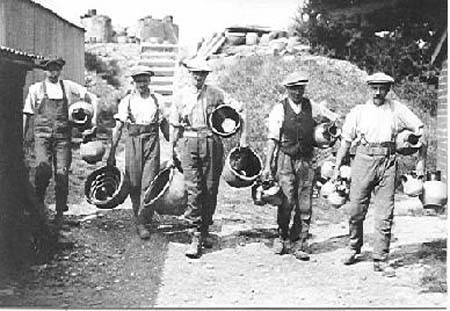
The picture of
the Cross roads pottery, shows the kiln being
unloaded in the 1930's. The men are understood to to
be from left to right; Mr. Jim Scammel, Mr. Brewer, Mr
Len Sims, Mr. Meshech Sims and Mr. Herbert Bailey. |
Heavy domestic earthenware had
fallen out of fashion as lighter enamelled goods became
readily available and so ended a craft which had flourished
in and around Verwood for many hundreds of years.
|