Horton North farm was at Old
Down before being replaced by new farm houses and buildings
Old Down was turned into five workmen’s cottages and the
water was obtained from a very deep well in a well house
nearby. The well had a big bucket let down through double
doors. When it filled at the bottom it was brought up by two
people one on each end of the double windlass.
What is now known as
Greenlands or
Woodlands Farm on the
Haythorne Road
was
the dairy part of North Farms
similar to Charlton. The dairy cottage still stands in the
field and the buildings were opposite in the corner. When
Greenlands Farm was built it
was intended to be built in the field close to the
Haythorn
Road, but after the
bricks etc had been placed there, the plans were changed
and everything was moved to the present site.
Manor Farm was always known to
the older people as `Woodlands
House` and the farmer there, as at other farms,
was looked upon in awe and was often saluted by the
villagers and workmen.
There were three holdings on
the Haythorne Road.
The one nearest Horton
was restored in the
1950s` before which one end consisted of a huge kitchen with
inglenook and surrounded by six doors leading to other rooms
and offices. Owing to this, the occupants used to have main
meals there but light a fire in the sitting room in the
afternoon and spend the evening there. Going towards
Woodlands the next holding on the other side of the road was
the village blacksmiths' shop and
wheel binding forge.
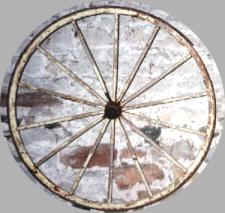 All the farm wagons and carts were
on wooden wheels surrounded by an iron bond. These bonds
were made slightly smaller than the wooden wheels. The wheel was
laid on a steel bed with a hole in the middle to allow the
nose of the wheel to drop into so that the wheel its self
laid level on the steel plate. The bonds were laid on the
ground and surrounded by dry wood and peat and fired. When
the bonds were red hot they were put over the wheels. In
heating this made the bonds to expand, making it possible to
put over the slightly bigger wheels. When fitted, they were
then doused with cold water to contract the wheels and
prevent them being damaged by fire.
All the farm wagons and carts were
on wooden wheels surrounded by an iron bond. These bonds
were made slightly smaller than the wooden wheels. The wheel was
laid on a steel bed with a hole in the middle to allow the
nose of the wheel to drop into so that the wheel its self
laid level on the steel plate. The bonds were laid on the
ground and surrounded by dry wood and peat and fired. When
the bonds were red hot they were put over the wheels. In
heating this made the bonds to expand, making it possible to
put over the slightly bigger wheels. When fitted, they were
then doused with cold water to contract the wheels and
prevent them being damaged by fire.
This smithy
was also a small holding and the farmers wife was very much
the boss and rationed all the food for the animals keeping
it in a back bedroom and letting it down to the centres. On
the other side further up, down a lane is Ivy Cottage Farm, leased and
farmed by Miss Weeks and helped by Sidney Keeping.
 Cross over the road again and on the common
was the village pound where any straying cattle were shut up
until the owner paid for their release and cost of food and
fine imposed. The last person to hold this office was Job Haskell. This is one of
the oldest names in the village and members of his family
leased several properties between the Pound and the present
Church. Job worked on the
St. Giles
Estate but also he was the
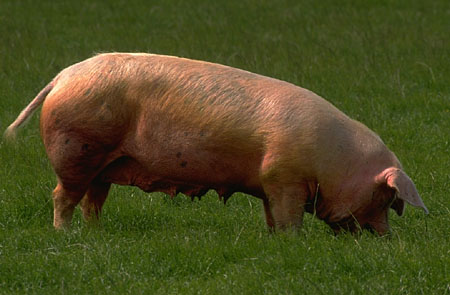
local pig killer. Almost every cottage kept one
or two pigs. They used to bring the pigs and the local shop
often allowed them to have meal on tick and then their own
garden vegetable supplies fatted the pigs to 150 to 200 lbs
dead weight. Then Job Haskell
was called in to kill and cut up one pig for the family`s
use. The other pig went to pay for the meal from the shop.
The pig for the family was salted for three weeks and then
hung in the inglenook chimney to dry for the coming year.
Cross over the road again and on the common
was the village pound where any straying cattle were shut up
until the owner paid for their release and cost of food and
fine imposed. The last person to hold this office was Job Haskell. This is one of
the oldest names in the village and members of his family
leased several properties between the Pound and the present
Church. Job worked on the
St. Giles
Estate but also he was the
local pig killer. Almost every cottage kept one
or two pigs. They used to bring the pigs and the local shop
often allowed them to have meal on tick and then their own
garden vegetable supplies fatted the pigs to 150 to 200 lbs
dead weight. Then Job Haskell
was called in to kill and cut up one pig for the family`s
use. The other pig went to pay for the meal from the shop.
The pig for the family was salted for three weeks and then
hung in the inglenook chimney to dry for the coming year.
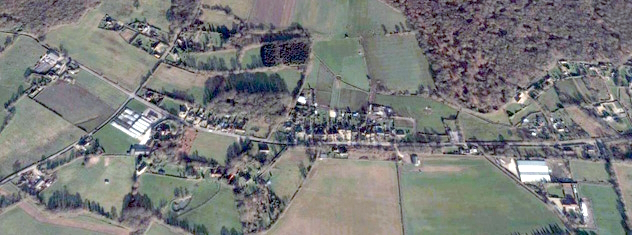
Woodlands Village in 2006.
Verwood is 1.5 Miles to the right of the picture.
Around Woodlands
Along the
footpath from `the Pound`
to
Woodlands
Church
was, and still is, a thatched cottage where “Friday”(Charles)Wilcox lived. He had a
wonderful gift in training pigs to do almost anything he
wanted. Charlie was a carter on the
Shaftesbury
Estate.
Next door
again under a yew tree (still standing) stood a pair of
thatched cottages. In one of these lived Sarah Haskell
who kept a small
shop in her porch where she sold half an ounce of sweets in
paper cones made by herself also tobacco and cigarettes, but
the 1914 war stopped this.
The other
cottage was the original Methodist
Chapel built by
Joseph
Haskell. On his death the life lease ran out and
the Methodists were turned out for quite a long period until
they were able to find alternative land on which to build.
Again the
next house on the common was occupied by Job Haskell`s sister
and her
husband William Froud.
On the common he tethered his shorthorn cow which us
children were afraid of as, owing to teasing by older boys,
it was rather bad tempered. He used to sell the milk at four
old pence a quart and the children used to collect it on
their way home from school. William also worked for the
Lord Shaftesbury Estate
in the
forestry department.
Between the
Pound and the crossroads in the new cottages (1912) lived
Charles Miles and his wife Rosanna.
He was totally blind and had to be led everywhere. Under the
same roof lived David (Piper) Cutler who left
to live in Parkstone and afterwards Charles Steel lived
there. He too was a Carter on the Shaftsbury
Estates also his father Tom who lived in the ‘Round House’.
Also in the
Round House lived
Wesley Cutler
who was the
local grave digger. Next door lived
Sarah
Barfoot who cleaned the church and school and
local washing. At one time the
Round
House housed four families, and it is said to have been built by the
Huguenots
as a linen factory when they were expelled from the low
counties.
In
Kings Lane
on the left in a
thatched cottage lived Joseph
Loader a bricklayer for
Lord
Shaftesbury. Lower down on the right under the
wood lived the Way family
of four sisters. A quarter of a mile on, on the right, was
the
keeper’s bungalow (1910)
lived in by Harry Wilcox,
his sister Mrs Drake
and her daughter Cis.
Back to
Woodlands crossroads and turn towards St.
Giles, on the right stood a thatched cottage
lived in by Ernest Barfoot (brother
of Sarah at the Round House) and his wife who
kept the village Post Office
for over 40 years. Ernie Barfoot
was a painter and decorator on
St.Giles
Estate.
Opposite was
the Estate Stables for the heavy Percheron Horses, six of
which were used to pull the heavy timber carriage from the
woods to the timber yards at Woodlands
and St. Giles with trees
to be used for building and repairs.
Next to the
Post Office
stands the Estate Bailiffs house and
office and behind the house stood a thatched shed with a saw
pit. Here trees were laid lengthways over the pit and one
man stood on top and another in the pit itself and pulled
the heavy pit saw up and down cutting out timber for use on
the Estate. This was done by two brothers, James and William Reed, but it
was discontinued about the beginning of the first war. By
the side of the stables is a lane and the small farm on the
right was farmed by William Hayter
who also had a slaughter house buying pigs, slaughtering
them and taking them to
Bournemouth,
together with eggs and vegetables.
At the top of
the lane is a pair of cottages in one of which lived
Sidney Keeping who managed
Miss Week’s
farm on the
Horton road.
He was a staunch Liberal, a Methodist local preacher and
also composed poetry.
Next door at
one time lived William Lockyer
and his family of five sons and four daughters. Back to the
crossroads and turn left to the village. On the left are a
pair of cottages built about 1912 and in one lived Mrs Kilford
an estate
foreman's widow and next door lived the
headmistress of the school (Miss Ellis).
Next came a
hall built for the Conservative
Association hoping to convert the mainly Liberal
inhabitants to their party.
This was not a great success as when they held a
dance or party, the young men of the village thought it
great fun to use their catapults
(forked weapons with rubber strings and a pouch to hold the
stone) to shoot out the lights in the entrance hall. These
catapults were deadly if anyone got in the way of a stone
and they were mainly used for poaching game and rabbits as
they made scarcely any noise only a swish. All this ceased
in 1914 when the great war came, as most of the young men
joined the armed forces, many never to return.
Looking over
the village green stands 2 pairs of cottages built by the
7th Earl of Shaftesbury. In the one nearest
the crossroads lived John (Jack)
Kerley and family, he worked in the estate timber
yard at St. Giles going on a very old fashioned bike. During the summer
months he used to come back from work to his allotment and
his wife had to have his tea (cooked) in time for his
arrival so that no time was wasted going home.
Next door
lived George Haskell (Georgey
Jimmy) and his sister. He had a small holding and
used his horse and van to take parties to various events.
The next house housed William
(Billy) Coles who worked in the gravel pits and repairing
roads which caused his back to be bent almost double. He was a class leader
and worked in the Sunday school all his life. His father lived in
the same house before him and when the school come church
was built he used to ring the bell calling the people to
worship then leave and go and worship with the Methodists. Under the same roof
lived Jimmy Reed and family,
he worked for the estate, first in the hand sawpit,
afterwards cleaving piles and erecting fences and gates.
(PICTURE
OF SCHOOL HOUSE)
Next came
the school and school house
where the teacher lived.
My first memory of school was Miss
Palmer 1913. She was about 5 feet tall but us
kids were scared stiff of her. She used to leave her
classroom to see her dinner was cooking and when she came
back there was pandemonium, which made her go mad and say
“the very idea, its preposterous, its absurd”. Of course
us kids never knew what these words meant but as she also didn`t mind using a ruler across your knuckles as well, we
were awed until next time. In the wood at the back of the
school we used to play foxhounds and in the winter the ponds
froze over and were used for sliding and falling in.
Next down the
road was a brick bungalow lived in by widow Annie Thorne and her eight
children. Behind her was a workshop of
Jackie
Loader who repaired clocks and metal work. He was entirely self
taught and if trained, would have been a mechanical
engineer. The
site of his workshop was fenced in by his grandfather, Stephen Hiskock, who built his
own abode of cob walls and thatched roof. Inside, a ladder
led to the upstairs but the roof was never sealed or
plastered, only just thatch.
Is it any wonder so many of these old buildings were
destroyed by fire. When
he took in this garden if a person
could put up a fence and bank, build a chimney to his future
home and have smoke coming out in 24 hours, he had squatters
right to the property. Little did Steve Hiskock and others know
when the steward of the Estate offered them a feast at Horton Inn
with plenty of
booze for one shilling a year, they were starting to pay
rent and at their death, the property would become part of
the St. Giles Estate.
Behind this
again was Tommy Miles
cottage, us kids were afraid for our lives of him. He was afraid his
wife would overspend, so he kept everything locked in
drawers carrying the keys around on his belt. One day when he was
ploughing a field, to his dismay he found the keys were
missing so he had to spend hours turning back the furrows
until he found them. Tommy
kept bees and Annie his wife bought a gramophone, which she
was very fond of playing.
One day the bees swarmed and flew away and Tommy was
in a rage because the gramophone drowned the sound of the
swarming bees. His
young son laughed at him which made him angrier than ever
and as he had rheumatism, when he went to chase Charlie he
was unsuccessful so all he could say was “Humbug laugh at I”.
(PICTURE
OF COUNCIL HOUSES)
All these houses are gone and were
replaced in 1939 by council houses. Next to the bungalow
lived Richard Tubbs known as Dicky. As the chimney always
smoked with the door shut Dicky had several holes bored in
the front door to cause more draught and so overcome the
smoke problem. He
also used to shout at the top of his voice and ask us kids
if we could shout louder.
We used to tease him and say he had a lot of money
hoarded (some hopes considering his wage until 1915 was
about fifteen shillings a week and never more than thirty
shillings). He
used to shout at the top of his voice “liar, liar theest
burn in hell talking like that”. Dickey was very fond
of chewing tobacco and after a while taking it out of his
mouth and putting it in his hat. He went to chapel on
Sundays in his best corduroy trousers and hob nail boots and
one Sunday took off his hat and went to his pew and to the
delight of the lads behind him his quad of tobacco was stuck
to the top of his head.
Dicky was a member of the Rechabite
Friendly Society but always managed to get his
contribution back. One
time he was supposed to have bad feet so he walked to Cranborne
to the doctor, 6
miles there and back, collected a certificate, then walked
to Chalbury, 4 miles
there and back in the afternoon, to hand the certificate
over to the society and get his benefit.
Before this
William Froud in about 1830
bought the life lease of a former Beer House known as
the “
Royal Oak
” and as his family grew up
and married, one to Martin Cutler,
William let them build next to Dicky Tubbs. Then another son
Martin, and daughter Kerturch married
Martin
Loader. They built a pair of cottages below the
former pub. Later William’s grandson lived in his home
until it was condemned in 1908, when it reverted to the
St. Giles Estate. His name was George
and his four sons were born there. He then went next
door where his uncle Martin Froud
had built. Both
his father Jesse and himself were timber cutters on the
St. Giles Estate. Next door again Robert Tubbs built his house
about 1830. This
was a small farm and his son Rolls
Lonnen Tubbs farmed it until about 1912 when
Alfred Miles (Tommy’s son)
took over. The
Lonnen in Rolls Tubbs name came from his mother Charlotte Lonnen of Cranborne. Next door again was a
cottage built and lived in by Levi
Cutler. After
his death Henry, their son, lived in part of the house and
as the living room was not ceiled when the upstairs floor
was bricked, the dust came down on the kitchen table.
About 200 yards down on the
south side of the road is probably the last cob building
built in Woodlands and it was built as two cottages. Later Fredrick Tubbs
who managed the nursery near the “Round
House” had a family of four daughters and eight
sons so the two cottages were made into one. They lost 2 sons,
Bert and Harry, in the first war. About 3/4 mile down
the lane in front of this house stood a keepers cottage in
the middle of
Woodlands
Park
. Next
door to the Chapel lived Freddie
Miller and his wife Fermy, he worked on the
Estate and being crippled he spent most of his time tarring
buildings and fences so the naughty boys called him
Freddie Tarpot. On the other side of
the road was a small holding worked by James
Potter. His
father Richard, farmed it before him and was known for his
quaint remarks. He
had one field smothered in weeds so he told a friend that he
and Herbie Bacon had
been and ploughed the field out of sight. Another time someone
asked Dickie if he could help him carry his hay. He replied I can come
if it rains but if it`s fine I want to carry my own.
Richard had a
new horse van built and went to collect it at Charles Sevior at Horton but
didn’t take his purse.
Charles would not let him take the van so he went
round to see Charles wife and borrowed the money from her.
Up the lane
by the side of this holding stood the
second Methodist Chapel in Woodlands built after the one
behind the Round House was taken away. When the
third chapel was built the 2nd was turned into a dwelling in
which lived Albert Tubbs and family. Their
youngest son Walter known as Skinner was a bit of a problem. When we were kids at
school we were terrified of him jumping out from behind
bushes in weird clothes.
When the foxhounds were about, he would climb a tree
and shout at the top of his voice (and sign he had seen the
fox) but when they arrived he was in a shed watching them
and laughing to himself at having made fools of them. When he came out of
the army after the first war he bought a new bicycle in
Wimborne. On the
way home one of the chaps with him said when they got to a
duck pond “ bet you wouldn’t ride your bike into that
pond Skinner”. “Wouldn’t
I” he replied and rode right into the pond and fell off in
the mud.
Opposite stood a pair of cob and thatched
cottages in the first
lived Mr. Turnell and
family, he was a retired sailor who sailed under
sail when he first went to sea. Next
door lived William Reed
and family. For
several years he worked on the Estate but later worked in
the brickyard by Verwood Station. A public footpath
runs in front of these cottages called “Pieces”.
In the 2nd cottage Eliza Ann Wilcox,
an elderly widow. Afterwards Herbie
Wilcox a retired butler who had a lovely tenor
voice. The next holding along was
occupied by Bartimeas Haskell who was very upset
if anyone touched anything belonging to him or even trod on
his land. This is the cottage where the Methodists
held a 24 hour prayer meeting and only drank
water when their chapel behind the
Round House was taken away. They prayed that the
steward who took away the chapel would have a change of
heart, or be removed. Within
a short time he died suddenly in Ireland
and his brother who
took over said “Let the Methodists have their chapel or
they will pray us all to death”.
Next door again stood a very small cob and
thatched cottage occupied by Alfred Loader. Alfred was the father
of Jackie near the school and he had a small holding and
also worked on farms part time. He was in great
demand for building cattle sheds, the walls being upright
stakes intertwined with gorse, the roof being thatched. They were very
popular with farmers because everything grew on their own
farms and so the only outward cost was less than £1.00 a
week labour costs and the animals were loath to damage the
prickly walls.
Again next
door lived Jackie and Jane Dowland. When I knew them they
lived a very secluded life, Jackie doing a few odd jobs such
as beating for game at the big game shoots or helping
thrashing corn or just scrounging any odd potatoes, corn etc
he could find. When
going out, his sister would always shout “John, John, here you got
your sack”. Older
people said as a young man Jackie was a proper dandy wth
silk hat and walking stick when he went courting Sarah
Haskell near the
Round House.
Jane I was told was a lady’s maid and travelled all
over the continent but literally her dress consisted of a
black blouse and a hessian sack for and aft as a skirt. They were both struck
down with pneumonia and died within a day or two of each
other. After
their death, neighbours burned all their belongings among it
was at least one book “1st Edition Hutchins History of
Dorset” which the local doctor knew they had and he told
someone he would have paid £25.00 for it and this was 50
years ago. They
were both buried in paupers graves in
Wimborne
Cemetery.
Following the
path through the Pieces over a wooden bridge we come to a
gravelled lane now known as
Whitmoor Lane. On our right was a
thatched cottage holding occupied by Ewart Tubbs he himself being self employed
in the woods making sheep hurdles and pens for thatching
etc and on the opposite side of the lane was another
holding occupied by his father, Lewis Tubbs who followed
the same occupation as his son, both helping on farms
during the summer season.
Turning left
onto the lane we come to a village bakery and general stores
started by James Cutler who also traded in underwood and no
doubt used the faggots to heat the bread oven. He was a strict
Methodist but it is said (not proven) a debtor met him one
Sunday and offered to square up . James said “I do
not take money Sundays”.
“Right” said the debtor, “I shall be gone in
the morning”. “All
right then” said James, turning his back to the debtor and
showing his back pocket “stuff it in here then”.
Leading off
to Jubilee farm were
3 thatched houses on the left hand side, the first was
built by the Dowland family.
In the early 18th century
felons who were found guilty of several crimes including
stealing livestock as well as murder were hanged and their
bodies taken to a gibbet and hanged in chains. One of these gibbets
was at West Parley and it was thought if anyone had certain
ills, a part of the felons body would cure it. One of the Dowland
family walked to the gibbet and picked up the felons toe
nail and brought it back to Whitmore. Whether it was the
thought of it, the family could not sleep or rest whilst it
was in the house. So the person who collected the toe nail
had to walk with it back to Parley and replace it where he
found it and sleep and rest came back to the cottage.
In the second cottage
lived George Haskell with a large family. During the summer
months he used to attend village fetes with his swing boats
and the frames of which he had built into horse drawn wagons
when he ceased this enterprise, but some of the boats were
still in the lofts in the 1940s. He also used to take
vegetables to
Poole
and sell in
Market Street, pea sticks and bean
rods to
Bournemouth
, as well as a small
holding and agricultural work for all and sundry.
The next
house was occupied by William Scott and he farmed the
Jubilee holding
whilst his wife had a small shop and bakery. At the Methodist
chapel they used to have at least five tea meetings a year
and Mrs. Scott and
Mrs
Cutler, four houses down the lane,
used to take turns in supplying the bread, cakes etc for
same and trying to see who made the tastiest cake.
Coming back out
Whitmore Lane
on the right, was a holding built by Jacob Wilcox and his
family, most of whom had either biblical or names of
reformers such as Luther, John, Wesley, Dinah etc. At first he was a
leading member of the Wesleyen Methodists opposite but
something went wrong so he left them and joined the Primitive Methodists at
Haythorne which meant about 6 miles
walk to the two services each Sunday. He was said in his
earlier days to be a champion scythe man often with a mate
starting to mow a field of hay or corn at daybreak and
continuing until the job was finished, no matter how long it
took.
On the
left handside, coming out of Whitmore Lane, was a thatched
cottage built by Samuel Froud, son of William at the top end
of the village and his wife Betsy, later it was occupied by
his grandson Harry who worked in the woods hurdle making.
The next house up the
hill lived John Haskell, brother of George, who lived in
Jubilee Lane. These
brothers were not a bit alike, George being devout Anglo
Catholic and a true blue Conservative. George a teetotaller
and John was the local cider maker. John was a follower
of the local foxhounds and used to open the gates for the
riders to pass through taking off his hat and saying “remember
poor old Jack sir” hoping to receive a sixpence (2 1/2p).
At other times one would think he and his family were the
lords of the Manor.
Next up the
hill was Charlie Thorne who through ill health did not do
very much work. The
next lived Job Cutler and his wife who had the nickname of
“Bridget” as she knew all the local gossip. The whole family, one
son and two daughters, used to work together making sheep
cribs which farmers filled with hay winter time for their
sheep. They also
went working on farms hoeing, hay making and harvesting,
going as far as Chichester living rough in farm buildings. One young man hoping
to earn extra wages went with them but only stayed a short
while. He said
Job was busy washing his feet when the groceries were
brought in. His
son picked up the cheese and said “nice piece of cheese
father”. The
old man took his feet and hands out of the water, grabbed
the cheese and said “put it down oaf you know you shouldn’t
handle food.” I
think this was the last straw for the young man as he came
home the next day. Job
and his family used to go to Wimborne on Saturday nights,
coming home very late in their donkey cart. One Saturday night
some lads of the village blacked out their windows with corn
sacks and Job and his family slept on until late afternoon.
Job was brother to
James who had the shop and bakery.
All these
cottages were demolished and bungalows built on the site in
the 1950s, also a thatched cottage father up the hill which
caused a blind corner, lived in by William Jacobs and his
wife Louise. It
was a small farm but all the land was taken to build the
council cottages and bungalows. Behind this holding
was another cottage occupied by William (Billy) Warne
a
hurdle maker. Down
what is now known as
New Road
lived Noah Jacobs and
opposite a holding farmed by
Harry Tubbs who was also in
underwood business buying this by the acre and having it
make into sheep hurdles etc.
When Mr. Pratt the agent for the St. Giles estate
wanted to increase his rent Harry asked him to look over
his farm. In
one field known as “starve all” Mr. Pratt said “nice
bit of land this Tubbs”.
Harry replied there are more wire worms a lug (rod)
there sir than there are devils in hell.
Farther down the
lane in Martins farm lived
Wesley
Wilcox and his daughter
and son-in-law Harold Bacon.
Wesley was also a hurdle maker and Harold helped on
the farm as well as horse haulage and agricultural
contracting. They
were staunch Methodists, Wesley being Sunday School
Superintendent for a great number of years followed by
Harold Bacon. Their
Sunday started at 9.30 am Sunday School till 10.30, morning
service 10.30 till 12.00 or sometimes 12.30, Sunday School
2.00pm
till
3.00pm
. Evening service
6.00pm
till
7.30pm
. During the winter
months the lane was impassable with mud, as wellington
boots had not been invented. So they walked through the
fields and common over the hill making each journey about
one and a half miles long so this meant about 9 miles each
Sunday and 2 or 3 times for week night meetings and
services. Wesley
lost one of his eyes as a young man, a flint flying up
whilst he was hoeing and he had to wear a black patch for the rest
of his life.
At the back
of this farm was Woodlands Park and the gamekeeper lived in
a cottage in the middle, but being such a big wood it was
almost impossible to keep the pheasants from straying to
there arable land outside, which meant a short stay for the
keeper.
In the early
part of this century Charles Cutler was the gamekeeper
and
he had several daughters who attracted the lads from the
village and Charles was on the strict side. One night he chased
some lads and they took refuge under a bridge and Charles
stayed on top waiting but he got tired first after, the lads
said, was (or seemed) 2 hours.
On the other
side of the park was a hamlet known as Knobs Crook, the
first holding being occupied by Charles Froud. The next holding was
farmed by Fred Chalk, who left in the 1930s to take over
Woodlands Manor Farm. The
next tenant was Mrs Chalks brother Oliver Wilcox who was a
bit of a dream. Everywhere
Oliver went he took his bicycle including one day in
Ringwood Market when he was pushing it down amongst the
drivers loading up pigs and the remarks used to him are
unprintable.
Behind this
farm, was another occupied by
Harry Gallop and his wife
Nellie who made a very poor existence as Harry did his grass
cutting etc by the date always whether it was an early or
late season. Next
came Slough Lane
farm occupied by
Joseph Lockyer afterwards Charles Hopkins and latterly by
Frank Froud. When
Harry Gallop left, it was occupied by Mr. Hawkins. In 1944 a German
bomber shed it’s load of oil bombs (still buried) also a
load of incendiary bombs.
Old Mr. Hawkins went out and started picking them up
in a wheelbarrow.
Frank
Froud told him to stop as a lot were unexploded and wanted
gentle treatment so the old man tipped them all in a heap
so Frank ran.
The next
cottage was abandoned in 1920 when the end fell out but the
Stride family renewed it with weather boarding and is still
in use 60 years later.
The next house was occupied by the
women
(Amy Farrant) who told James II soldiers she had seen the Duke of
Monmouth and he was caught a short distance away under an ash tree in a ditch forming the boundary between Woodlands
and Horton Parishes.
It is said the old woman that betrayed
Monmouth became lousy and the older people always called
Slough Lane
-
Louse Lane
. It could be
after the Bloody Assize she was scorned by other people and so neglected herself.
A farm
surrounding Monmouth Ash and bearing that name was farmed
for many years by Jethro Wilcox. At that time when a farmer
thrashed his corn, the workers on the machine had a cooked
dinner provided. When they went to this farm the joint was
half a pigs head 90% bone so Jethro said to his wife “who’s
going to carve mother you or I”.
After his
wife’s death he lived alone several years and some young
chaps working nearby were invited in to eat their packed
lunches as the weather was bad and they always remembered
Jethro’s dinners consisting of a frying pan full up with
cabbage and bread. Anyway he lived to a good old age so it
must have suited him.
Coming back
towards Woodlands via Davis Cross we come to Wedge Hill Farm
where “Tommy” Young lived, a rather poor sandy holding,
he mainly kept sheep which he folded on other peoples land
and on one field at Knowle Hill about 3 miles from home. As
boys we used to tease his ram and he told a friend “I can’t
understand why that friendly ram has got so bad tempered. I
have got to put a hurdle in front of me when I go into the
fold” he later went to Pentridge to live.
On the other
side of Wedge Hill was another holding that had been
reclaimed from the common in the early 19th century by an
old lady named Jenny Clench who was reputed to be a witch
and was supposed to turn herself into a hare and find out
what was happening in the outside world. When the St.Giles
Estate Agent tried to get her to start paying one shilling a
year for a dinner at Horton Inn whereby she would be paid
rent on her holding she told him to keep his dinner and she
would keep her one shilling. By doing this she not only kept
the freehold but also the right to turbary rights and also
to shoot over the common. During the 1914-18 war this
holding was bought by a Mr.Searles who had been
disposesed by
the War Department on Salisbury Plain who needed his land
for chemical warfare purposes.
Adjoining
this holding was Mount Pleasant Farm which was tenanted by
Mr. Joe Collins
who had also been disposesed by the War
Department so two people became neighbours again. Both Mr
& Mrs Collins had been married before and also had four
children of their own and the combined family amounted to
about 20. Soon after they came they were made homeless again
this time by the farmhouse burning to the ground. At one
time there were four cottages at Mount Pleasant